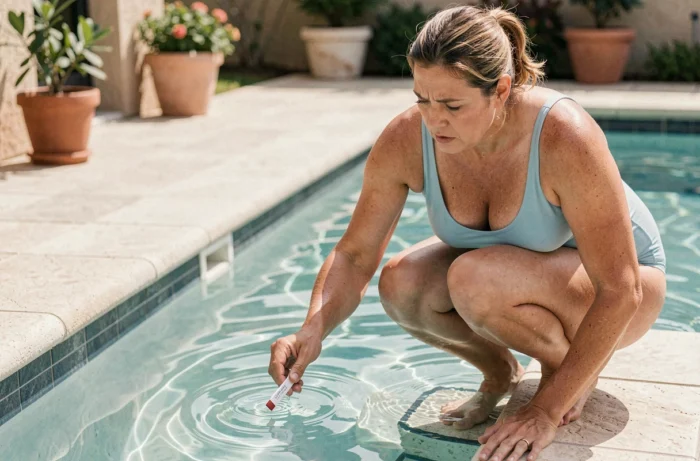
Salt electrolysis generates chlorine, but also caustic soda. This by-product continuously pushes the pH up, and the drift is not accidental: it is inherent to the process. Understanding this mechanism changes the way to manage the pool, because the corrections applicable to a pool treated with stabilized chlorine are not sufficient here.
Production of caustic soda and pH drift in saltwater pools
The electrolysis cell breaks down sodium chloride into sodium hypochlorite (the disinfectant) and sodium hydroxide (the soda). This soda is directly responsible for the rise in pH. The longer the cell operates, the greater the amount of soda released.
In peak season, we observe a rise in pH of 0.1 to 0.3 units per week on a pool equipped with an electrolyzer operating at normal capacity. With a fill water already at 7.4, the critical threshold of 7.8 can be exceeded in less than two weeks without correction.
This is a fundamental difference from treatment with chlorine tablets: in this case, the pH tends to decrease due to the effect of isocyanuric acid (stabilizer). In salt electrolysis, the trend is systematically upward. An article detailing the consequences of a pH that is too high in a saltwater pool confirms that this structural drift affects both disinfection and the longevity of equipment.
This phenomenon intensifies when the water temperature rises, because the electrolyzer produces more chlorine (and thus more soda) to compensate for the accelerated degradation of chlorine by UV and heat.
Scaling of the electrolysis cell and water hardness
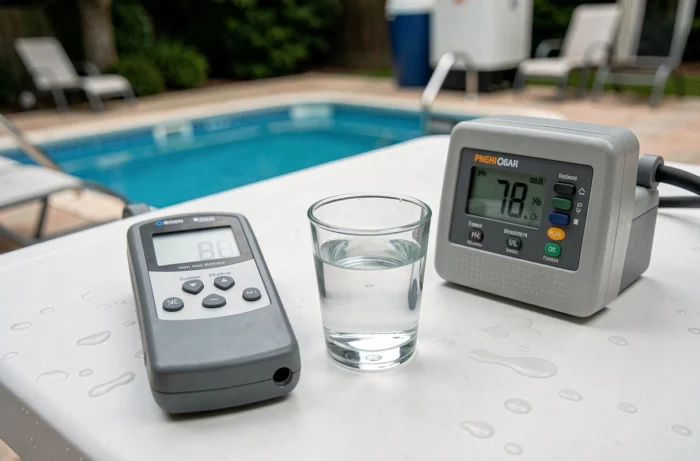
A high pH combined with hard water creates ideal conditions for rapid limescale deposition on the electrodes. Beyond 30 °f of hydrometric title, scaling of the cell accelerates significantly, reducing the active surface and forcing the device to consume more energy to maintain its chlorine production.
Self-cleaning cells (polarity inversion) delay the problem but do not eliminate it. When the pH stagnates above 7.6 in hard water, the inversion cycle is no longer sufficient to detach the calcite plates. We then recommend an acid descaling of the cell every two to three months, compared to once or twice a season under normal conditions.
The direct consequence: a scaled cell produces less chlorine, which leads some owners to increase the operating time of the electrolyzer, which generates even more soda and worsens the rise in pH. The vicious circle is in place.
Parameters to monitor alongside pH
- TAC (Total Alkalinity): a TAC that is too high acts as a buffer that prevents the pH from dropping despite the addition of acid. We target it between 80 and 120 ppm to maintain an effective correction margin.
- TH (Hardness): water with a TH exceeding 25-30 °f requires a softener upstream or a lime sequestrant, especially with an electrolyzer.
- ORP (Oxidation-Reduction Potential): this is the real indicator of disinfecting power. A pH of 7.8 may show a correct free chlorine level on the colorimetric test, but the ORP reveals that the active fraction of chlorine (hypochlorous acid) has dropped significantly.
Decrease in the disinfecting power of chlorine beyond pH 7.6
Free chlorine exists in two forms in water: hypochlorous acid (HClO, a powerful biocide) and the hypochlorite ion (ClO⁻, much less active). The ratio between the two directly depends on the pH.
At pH 7.2, the proportion of hypochlorous acid is predominant. At pH 7.8, the hypochlorite ion dominates. In terms of disinfection, a pool at pH 7.8 disinfects significantly less than a pool at pH 7.2 for the same free chlorine level. The health risk increases without the test strip sounding the alarm, since it measures total chlorine, not the active form.
In a saltwater pool, this loss of disinfecting power is insidious. The electrolyzer continues to produce chlorine, the user sees a correct level on their analyzer, but the water turns green or cloudy. The classic reaction (increasing production) exacerbates the pH drift instead of addressing the cause.
Automatic pH regulation on a salt electrolyzer
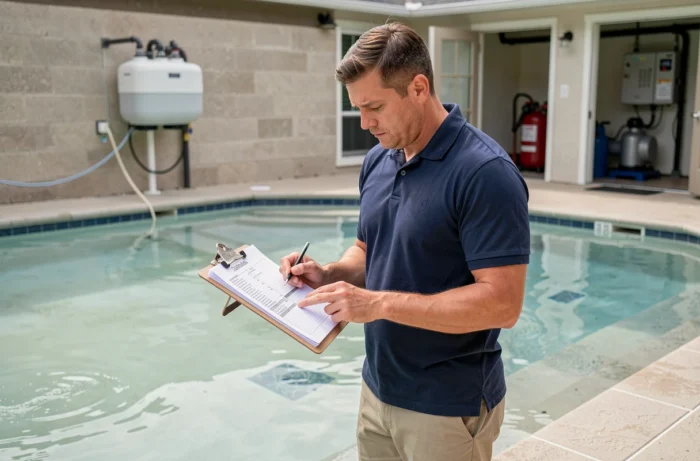
The installation of a pH minus (acid) dosing pump coupled with a pH probe is almost essential on a salt pool. Combined electrolyzer-regulator systems are becoming increasingly common, with a pH probe and sometimes an integrated ORP probe.
Some points of vigilance for the regulation to work effectively:
- The pH probe must be calibrated at least once a month with pH 7 and pH 4 buffer solutions. A probe offset by 0.2 units skews the entire regulation.
- The correcting product (diluted hydrochloric acid or sulfuric acid) must be injected after the filtration point and before the return, never directly into the skimmer.
- The flow rate of the dosing pump is adjusted according to the volume of the pool and the observed drift rate. A one-time overdose of acid can cause the pH to drop sharply and damage the seals, the cell, and the liner.
- The ORP probe complements the pH probe: it indicates whether the chlorine produced is truly active, which the pH alone cannot verify.
Without an automatic regulator, manual monitoring requires checking at least every two days in summer. Sodium bisulfate (pH minus in granules) remains the most commonly used manual corrective, but its dosage must be gradual to avoid spikes.
Consequences on the liner and pool equipment
A pH consistently above 7.8 promotes limescale deposition not only on the cell but also on the walls, the waterline, and the return jets. On a liner, these deposits create a roughness that traps algae and complicates cleaning. Ingrained limescale in a liner reduces its lifespan by several seasons.
Heat pump exchangers are also vulnerable. Scaling of the exchanger decreases thermal efficiency and can trigger flow defects on the device. The cost of replacing an exchanger far exceeds that of a pH regulator.
A high pH in a saltwater pool is not just a comfort parameter. It is a technical factor that conditions the performance of the electrolyzer, the quality of disinfection, and the durability of each component of the hydraulic circuit. Managing pH is protecting the entire system.