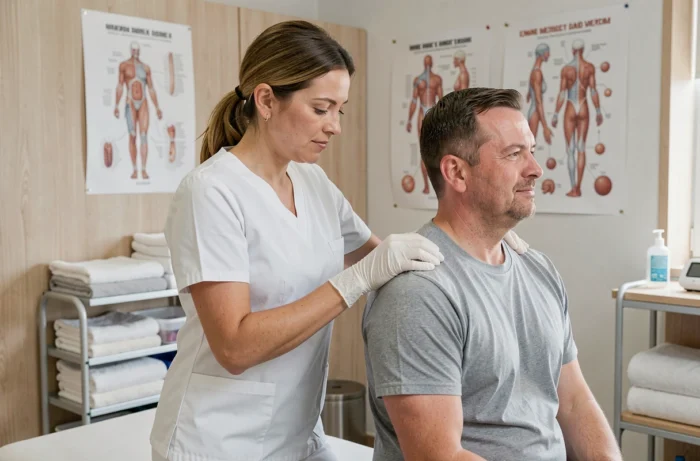
The decree of September 16, 2026, published in the Official Journal, replaces the regulatory list of 2006 and redefines the scope of prescription for physiotherapists. This text constitutes the most significant regulatory change for the profession since the establishment of direct access. Here, we analyze its concrete implications, the limits to integrate, and the technological developments that accompany this transformation.
Physiotherapist Prescription: Actual Scope of the September 2026 Decree
The decree authorizes the prescription of an expanded set of medical devices and certain medications. Physiotherapists can now prescribe mobility aids, medical beds, transfer devices, certain orthoses, as well as monitoring equipment such as blood pressure monitors or pulse oximeters.
In terms of pharmacology, the text includes level I analgesics, muscle relaxants, mucolytics, and local antiseptics.
We observe that this competence remains framed by a clear limit: the prescription only concerns the scope of competence of the physiotherapist. A physiotherapist can only prescribe an analgesic within the context of care relevant to their practice, not in response to a request disconnected from the ongoing rehabilitation. The regulatory monitoring provided by physio-mag.com allows professionals to follow these textual developments as they are published.
Risk of Requalification as Illegal Practice
Prescribing a device outside the scope of physiotherapy competence exposes one to disciplinary requalification. The texts do not define a closed list of indications by product, which leaves a gray area that the Order will likely need to clarify through practical recommendations.

Direct Access in Physiotherapy: Initial Feedback on Claims
Direct access, which allows patients to consult a physiotherapist without prior medical prescription, now extends beyond just health centers and clinics. The initial institutional feedback, cited by Egora in September 2026 from the Cnam Charges and Products report, does not report an increase in claims.
This observation deserves to be contextualized. The absence of a negative signal at this stage does not equate to long-term validation. We recommend monitoring the upcoming publications from Cnam to verify the stability of these results over a larger cohort and a longer duration.
Impact on Care Pathways and Access Times
The main issue of direct access is not technical but organizational. It shortens the time between the onset of symptoms and the first rehabilitation session. In areas underserved by doctors, this access reduces the latency time that exacerbates certain chronic musculoskeletal pathologies.
Alternatives Économiques raised the question in September 2026, “Are the French going to the physiotherapist too much?” The answer depends less on the volume of sessions than on their clinical relevance. Direct access, if well calibrated, directs the patient earlier towards the appropriate care without multiplying intermediate consultations.
Measurement Technologies in Rehabilitation: Dynamometers, Sensors, and Surface EMG
Quantification tools objectify parameters that manual assessment does not capture accurately. Three categories stand out by their clinical maturity:
- Connected dynamometers: they measure muscle strength with superior reproducibility compared to manual testing, facilitating longitudinal tracking and bilateral comparison
- Force platforms and inertial sensors: they analyze weight distribution, movement speed, and power, providing actionable data to adjust rehabilitation load in real-time
- Surface electromyography (EMG): it detects invisible muscle compensation strategies, particularly in post-operative rehabilitation of the knee or shoulder
These devices do not replace clinical reasoning. Their contribution lies in the ability to document progress, argue for a return to sports, or justify the extension of care to payers.
Tele-rehabilitation and Artificial Intelligence
Tele-rehabilitation has gained credibility over the past few years. Current platforms offer asynchronous monitoring of prescribed exercises, with algorithms that alert the practitioner in case of deviations from movement parameters.
Artificial intelligence primarily intervenes in predictive analysis: identifying patients at risk of chronicity, suggesting protocol adjustments based on aggregated data. These tools remain aids to decision-making, not autonomous systems.
Coordinated Practice and CPTS: Structuring Liberal Practice
Territorial professional health communities (CPTS) provide a framework for coordinated practice that goes beyond mere sharing of premises. For liberal physiotherapists, joining a CPTS facilitates direct access by securing the patient pathway through formalized referrals with local doctors.
Coordination is concretely reflected in shared protocols: referral criteria, thresholds for redirecting to the doctor, common follow-up indicators. Without this structuring, direct access risks functioning in silos, which would weaken clinical traceability.
Physiotherapists practicing in CPTS also benefit from a collective negotiation lever with the ARS for zoning and installation incentives. In areas classified as under-served, these provisions condition access to certain financial aids.
The expansion of prescription competencies, combined with direct access and technological tools, reconfigures the role of the physiotherapist in the healthcare system. The profession gains clinical autonomy, but this autonomy comes with increased obligations for traceability and coordination. Practitioners who master both the regulatory framework and objective measurement tools will be best positioned to meet the growing demands of coordinated care pathways.