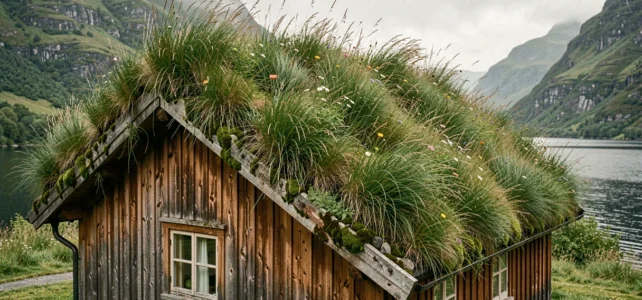
On the windy plateaus of Hardangervidda or in the wet valleys of Vestland, grass-covered roofs are not a decorative whim. They meet a concrete constraint: to protect a wooden structure from nearly constant rain and frost, using materials available on-site. This ground logic, which is centuries old, explains why Norwegian green roofs continue to be installed on new constructions, including in urban areas.
Birch bark and soil layer: the traditional installation technique
We often talk about “grass roofs,” but the vegetation is just the visible part. The real work happens underneath. The classic Scandinavian method relies on a precise layering of components, each having a distinct structural role.
- Birch bark serves as a waterproof membrane. Laid in several layers on the beams of the structure, it prevents water from penetrating while allowing vapor to escape outside.
- A layer of soil, sourced locally, covers the bark. Its thickness varies according to the roof slope and the region’s climate, but it rarely exceeds about twenty centimeters for extensive roofs.
- Vegetation establishes itself naturally or through seeding: grasses, mosses, and sometimes even small shrubs. It stabilizes the soil and limits erosion from wind and rain.
This system works because each layer compensates for the limitations of the previous one. The bark alone would degrade under UV; the soil alone would slide down the slope; the grass alone would have nothing to root into. It is the assembly that holds.
For those who wish to learn more about Habitat Solutions, the constructive logic of these roofs is detailed there along with their contemporary variants.
Managing runoff: why green roofs interest cities
The image of a cabin isolated in a fjord is appealing, but it masks a more recent use. Green roofs are now discussed as a solution for urban runoff management, not just as a heritage legacy.
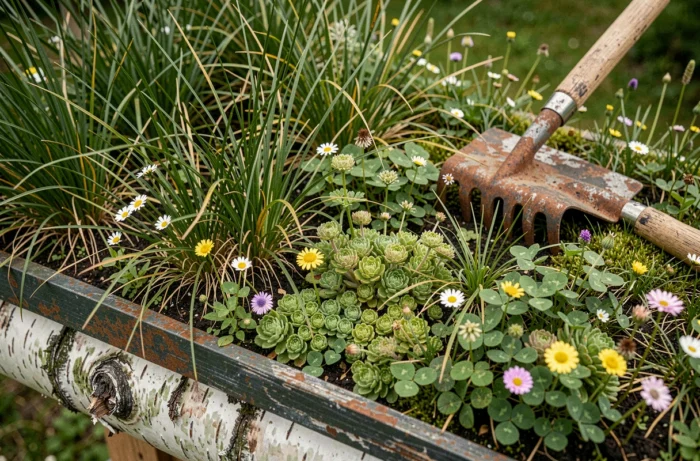
The principle is straightforward: during a rainy episode, the substrate layer absorbs some of the water before it reaches the drainage system. This time delay reduces peak runoff, which saturates pipes and causes localized flooding.
Feedback varies on this point depending on the thickness of the substrate, the slope, and the type of vegetation. A thin extensive roof does not retain as much as a semi-intensive roof with a thicker substrate. The so-called “blue-green” versions, which combine vegetation and water retention in a specific drainage layer, seem to perform better for this use, but they add weight to the structure.
A complement, not a replacement
You do not replace a sewage system with green roofs. They integrate into a broader climate resilience strategy, alongside swales, rain gardens, and permeable pavements. Their value increases when they cover a significant area at the neighborhood scale.
Green roof, cool roof, or biosolar roof: field comparison
Installing a green roof is no longer the only option when looking to improve a building’s thermal performance through its roofing. Two alternatives are increasingly circulating in projects: cool roofs (reflective roofs) and biosolar roofs that combine photovoltaic panels and vegetation.
The green roof offers appreciable thermal inertia. The layer of soil and vegetation slows down the transfer of heat into the building. In summer, the evapotranspiration of plants produces a cooling effect. However, this effect heavily depends on the time of day and the moisture available in the substrate. A dry green roof in a heatwave cools significantly less than a properly irrigated roof.
The cool roof, on the other hand, reflects solar radiation from the first hour of sunlight, requiring no maintenance. Its limitation: it does not provide any benefits in terms of biodiversity, water retention, or acoustic insulation.
The biosolar roof attempts to bring together both worlds. The vegetation maintains a lower surface temperature around the panels, which improves their electrical efficiency. The panels, in return, create shaded areas that diversify the growth conditions for plants. Recent comparisons suggest that this combination may outperform the green roof alone in terms of energy produced and biodiversity supported.
Adapting a Norwegian green roof to the framework of a modern construction
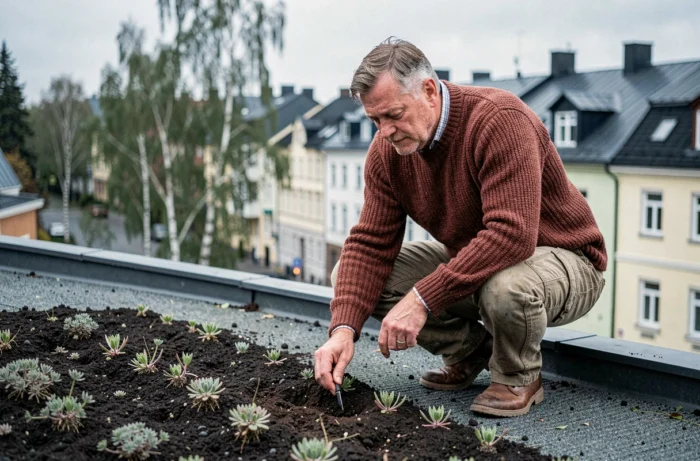
The ancestral technique works on structures designed to support the load. On a contemporary building, one does not place a layer of soil on a structure intended for lightweight tiles without checking the load-bearing capacity.
Three technical points deserve examination before launching a project:
- The permanent load of the water-saturated substrate is the first criterion. A rain-soaked substrate weighs significantly more than the same dry substrate. The structure must withstand the worst-case scenario, not the average case.
- Modern waterproofing replaces birch bark with synthetic membranes (EPDM, modified bitumen, PVC). Their installation requires a minimum slope and careful detailing at the edges.
- The choice of vegetation dictates maintenance. Sedums require little intervention; tall grasses or perennials need at least one to two visits per year for weeding and substrate checks.
Building performance and heritage: two converging logics
In recent Nordic projects, the question is no longer just about reproducing a traditional roof for its visual charm. The aim is to make the green roof compatible with current thermal requirements: enhanced insulation, properly positioned vapor barriers, and ventilation of the under-roof.
A poorly designed green roof can trap moisture and degrade insulation within a few years. The vegetation layer does not replace effective insulation; it complements it. On this point, Norwegian tradition and modern engineering converge: the green roof works when each layer fulfills its role without encroaching on that of the next.
Norwegian green roofs have stood the test of time because they address a concrete problem with simple materials. Their adoption in urban contexts or on modern buildings relies on the same logic, provided that one does not confuse the bucolic image with the technical reality of a roof that must last.