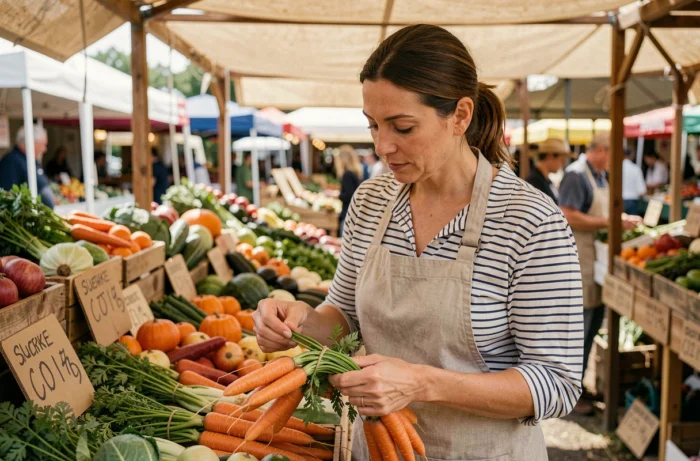
A local organic product does not automatically guarantee a better environmental impact than a conventional product grown a few kilometers away, or than a seasonal imported product. The actual sustainability depends on the combination of the production method, the distance traveled, and seasonality. Understanding these three variables allows for truly coherent food choices aligned with a sustainable approach.
Agricultural Production Phase: Where the Real Environmental Impact Happens
Transport often represents an overestimated share of the carbon footprint of food. The majority of food-related environmental impacts occur during the agricultural production phase: soil type, inputs used, irrigation, yields. A vegetable grown in a heated greenhouse near you can generate more emissions than a field-grown vegetable imported from a region where the climate allows for cultivation without energy input.
The production method weighs more heavily than the distance traveled in most cases. Organic farming eliminates synthetic pesticides and chemical fertilizers, which reduces soil and groundwater contamination. However, it does not guarantee a lower carbon footprint on its own, especially when lower yields require more cultivated land.
This is why crossing criteria becomes useful: an organic, local, and seasonal product combines the most favorable conditions. Several platforms facilitate this approach by bringing together producers engaged in short and certified supply chains, such as lebioducoin.fr, which lists local organic products.
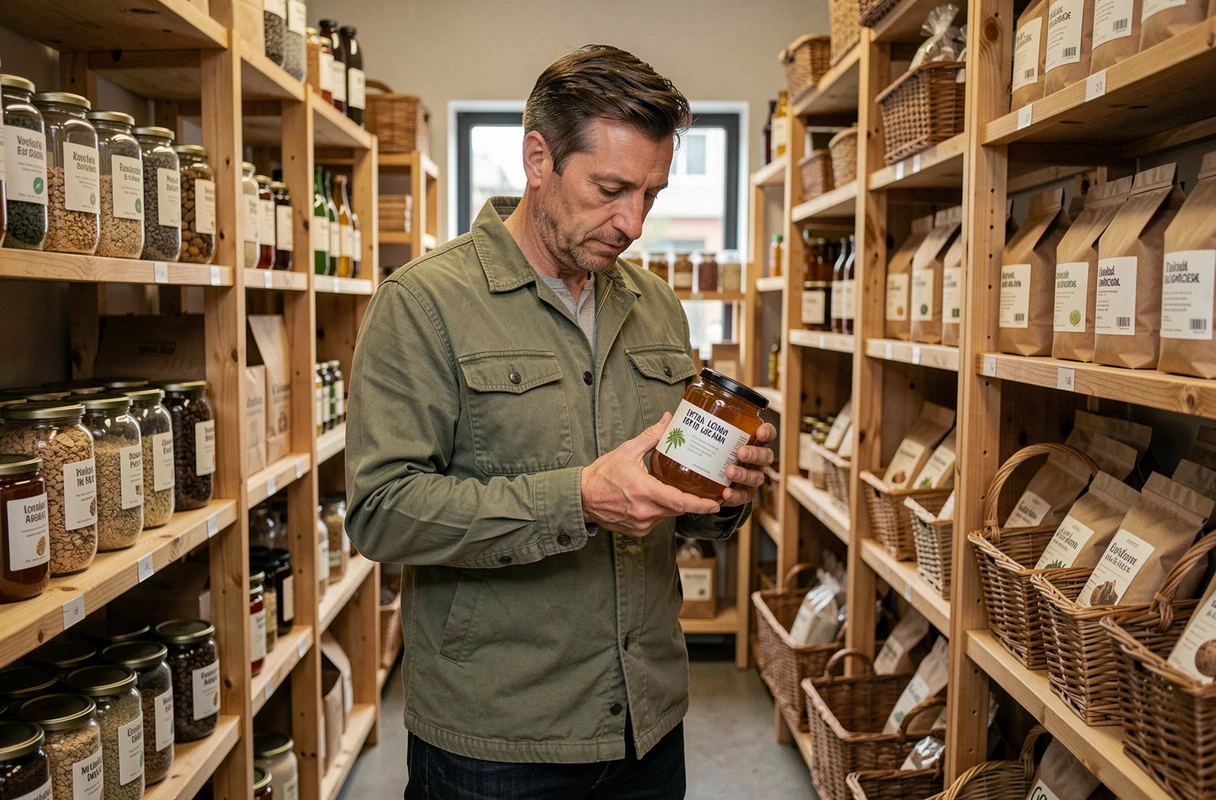
Organic and Local: Under What Conditions is the Combination Truly Sustainable?
Claiming that a local organic product is systematically more virtuous than a non-organic or imported product would be an oversimplification. Effective sustainability depends on specific conditions.
Seasonality as a Determining Criterion
An organic fruit grown locally but out of season, in a heated greenhouse, loses much of its environmental advantage. Seasonality neutralizes or amplifies the benefits of organic and local. Consuming seasonal vegetables grown in open fields remains the most effective lever for reducing the footprint of a meal.
Long-Distance Transport vs. Intensive Local Production
A product imported by ship from an area where it grows naturally, without irrigation or heating, can have a carbon footprint comparable to that of a locally grown product cultivated intensively. Maritime transport, relative to the weight transported, remains low-emission compared to refrigerated road transport over short distances.
The relevant question is therefore not “organic or local” in isolation, but: was this product grown in suitable climatic conditions, without energy forcing, and transported by a low-impact mode?
Organic Certification and Short Supply Chains: What the Label Concretely Brings to Local Producers
Organic certification provides an official framework for traceability. It imposes regular inspections, prohibits synthetic pesticides and GMOs, and requires a land conversion period before the label can be claimed. For consumers, this framework enhances trust. For producers, it opens access to specialized sales channels, often better compensated than conventional supply chains.
Short supply chains associated with local organic products provide an additional advantage: they promote the rediscovery of old varieties absent from large distribution. These varieties, often discarded because they do not transport well over long distances or have a long shelf life, regain a place when sold directly or through local networks.
- Varieties calibrated for export prioritize transport resistance and visual uniformity, at the expense of taste and genetic diversity.
- Short supply chains allow for harvesting at maturity, improving the nutritional and taste quality of fruits and vegetables.
- The direct relationship between producer and consumer reduces intermediaries and maintains a larger share of the final price with the farmer.

Health and Pesticides: What Organic Food Changes Concretely
Conventional fruits and vegetables are among the foods that contain the highest levels of pesticide residues, particularly leafy green vegetables, apples, and grapes. Chronic exposure to these residues, even at low doses, has been the subject of numerous studies published since the mid-2000s.
In children exposed in utero, cognitive development delays and behavioral effects have been observed. A correlation has also been established between pesticide exposure and the incidence of leukemia in children. For the farmers themselves, direct contact with these substances poses a documented occupational risk.
Choosing products from organic farming mechanically reduces exposure to synthetic pesticide residues. This health benefit is even more pronounced for foods consumed raw and daily: salads, fruits, aromatic herbs.
A Framework for Sustainable Food Choices in Daily Life
Rather than a single rule, a simple decision framework allows for evaluating each purchase:
- Is the product in season in your geographical area? If so, prioritize local organic. If not, a seasonal imported product from a suitable area may be more coherent than a locally grown product cultivated in a greenhouse.
- Is the production method transparent? Organic certification guarantees a minimum of traceability. In short supply chains, direct discussion with the producer complements this information.
- Was the product harvested at maturity? An organic fruit picked too early to withstand transport loses some of its qualities. Proximity favors harvesting at the right time.
- Seasonality, production method, and distance form a triangle: no single criterion is sufficient to qualify a product as “sustainable”.
The choice between organic, local, and imported does not call for a single answer. An organic-local seasonal product remains the most favorable scenario in health, environmental, and economic terms. When this combination is not available, making decisions based on season and cultivation method remains the most reliable way to reduce one’s food footprint.