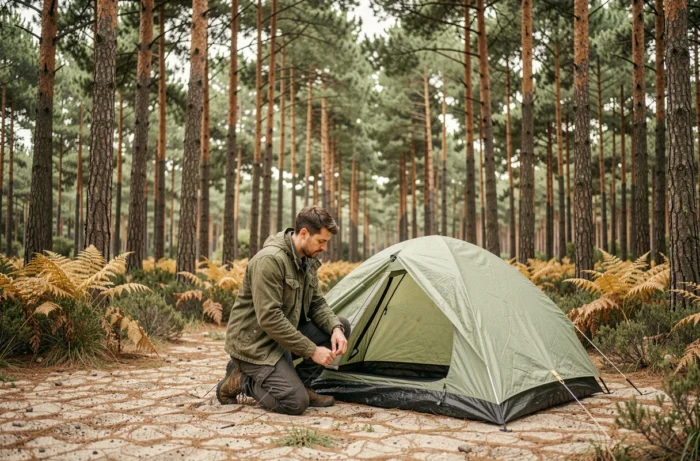
Setting up your tent in the Landes forest on a summer evening without being moved at dawn requires more than just a good feeling on a map. Wild camping in the Landes faces a shifting legal landscape, with prefectural orders related to fire risk and a land reality where almost all forest plots belong to private owners. Before choosing a spot, it’s wise to understand what separates a tolerated bivouac from an infraction.
Fire Orders in the Landes Forest: The Trap That Cancels Your Spot
You spot a perfect place under the pines, away from the roads. The next morning, an ONF agent reports that the area is under a temporary prohibition order. In the Landes, fire orders can render a location unusable overnight, even for simple bivouacking without a fire.
These restrictions are not only about open flames. During high or red vigilance periods, the use of stoves is prohibited in forested areas, and prolonged parking in the underbrush can be fined. The Landes pine forest, the largest in France, has a particularly monitored risk of wildfires by the prefecture.
Specifically, before leaving, check the fire vigilance level of the department on the Landes prefecture’s website. If the vigilance is orange or red, forget the forest and opt for a spot by the lake or on private land with written permission. When looking for where to practice wild camping in the Landes, this verification is the first reflex to have, well before consulting a map of spots.
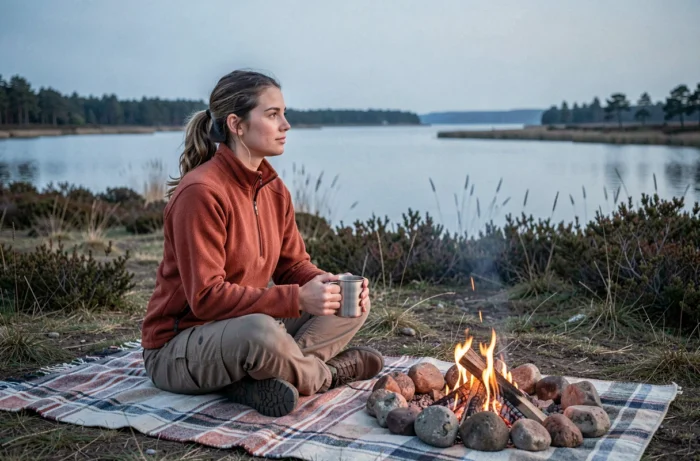
Private Land, Tolerated Bivouac, or Prohibited Area: Three Statuses to Distinguish
The most common confusion among campers is treating the Landes forest as a free space. In reality, three land statuses coexist and radically change what you are allowed to do.
- Private land with the owner’s permission: this is the safest framework. A forest or agricultural owner can allow bivouacking on their plot. You ask, you get permission (ideally in writing), and you respect the place. Platforms like lecampingsauvage.fr list private gardens open to campers in the department.
- Tolerated bivouac areas: some municipalities do not fine nocturnal bivouacking (setting up after sunset, leaving early in the morning) outside protected zones. This tolerance is not a right. It can be revoked at any time by municipal order.
- Explicitly prohibited areas: nature reserves, classified sites, surroundings of historical monuments, protected coastal zones. In the Landes, the dune cord is systematically prohibited for camping in all its forms.
Confusing these three statuses exposes you to a fine. Wild camping on private land without permission remains an infraction, even without a visible prohibition sign.
Bivouac Spots in the Landes: Types of Terrain That Work
Rather than listing GPS coordinates that would be outdated by the next season, it’s more efficient to reason by type of terrain. Each category has its specific advantages and constraints in the department.
Lakes and Landes Ponds
The back-dune ponds (Aureilhan, Soustons, Hardy) often offer accessible banks and a nearby water source. Avoid the shores in Natura 2000 areas and set up further back, on the unprotected parts. The advantage: these spots remain accessible even during fire vigilance periods in the forest massif, as proximity to water reduces the risk.
Clearings in Production Forests
The maritime pine plots in forest rotation (recent cuts, young replantings) are sometimes more open and less monitored than dense forests. Check the ownership and ask. A forestry owner who knows you won’t make a fire is often more accommodating than you might think; feedback on this varies by municipality.
Natural Camping Areas
Halfway between wild camping and traditional camping, natural areas offer spots in nature with minimal services (water point, basic sanitation). They are regulated but inexpensive, and represent a legal compromise for camping in a natural setting without giving up the wild environment.
Van and Motorhome in the Landes: The Legal Boundary Between Parking and Camping
Sleeping in a registered vehicle parked in a public parking lot is not camping. But as soon as you bring out a table, wedges, an awning, or a canopy, you legally transition into camping, and the rules change.
The distinction between parking and camping relies on the external elements deployed. A van with closed doors in an authorized parking lot poses no problem. The same van with an awning deployed and chairs outside can be fined, even in a spot where parking is allowed.
In the Landes, several coastal municipalities have enacted specific orders against the prolonged parking of motorhomes in coastal parking lots, especially during high season. It’s advisable to inquire at the town hall before settling in for the night. Service areas dedicated to motorhomes (Labenne, Lit-et-Mixe) remain the most reliable option for a stress-free night.
Checklist Before Setting Up Your Tent in the Landes
Here’s a summary of the checks to make before each setup, because forgetting one can turn a night in nature into a fine or an eviction.
- Check the fire vigilance level of the department on the day of departure.
- Identify the land status of the targeted plot (private, communal, protected) via the online cadastre or at the town hall.
- Request the owner’s permission if the land is private, even for just one night.
- Check for the existence of a municipal order prohibiting camping or nocturnal parking in the municipality.
- Do not deploy any external equipment if sleeping in a van or motorhome in a public parking lot.
Wild camping in the Landes remains feasible as long as you accept that it cannot be improvised. Every night in nature requires specific preparation for the plot and the season. Campers who take the time to check the land status and fire risk level sleep peacefully, while others gamble with the regulations.