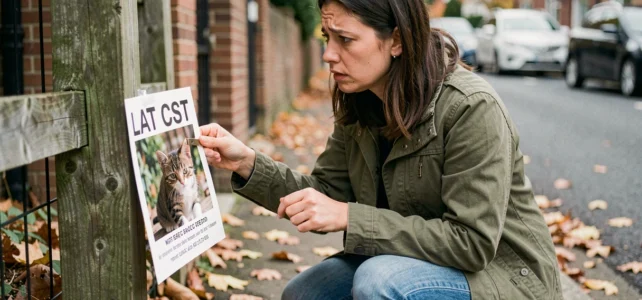
In 2025, the national I-CAD database recorded over 90,000 animals reported lost, and less than half were reported found. Behind this statistic lies an operational reality: the first hours after a cat goes missing largely determine the outcome of the search. A weaned kitten or a female cat in heat does not behave like a neutered male accustomed to going outside, and search techniques must adapt to each profile.
Movement Radius and Escape Behavior According to the Cat’s Profile
A neutered adult cat rarely exceeds a radius of a few hundred meters around its home. A kitten under six months old, on the other hand, moves even less far but hides in extremely confined spaces: ventilation ducts, under terraces, inside car engines.
An unspayed female cat in heat can cover a significantly greater distance, attracted by males or driven by hormonal agitation. Spaying greatly reduces this risk of long escapes.
The key point to remember: a lost cat that does not return is not necessarily far away. It is often held back by fear, an injury, or accidental confinement (garage, basement, neighbor’s garden shed). We recommend focusing the initial searches on a very short radius, opening or requesting access to every closed space in the immediate vicinity.
When the disappearance occurs in an unusual context (vacation spot, recent move, car transport), the cat loses its scent landmarks. It then immobilizes itself more quickly, often within the first few meters after the point of escape. Trying to call it out loud is counterproductive with a terrified animal.
It’s better to place warm, strongly scented food (tuna, warmed wet food) and return to check every two hours, preferably at dusk or dawn, when human and noise activity decreases.
Microchip and I-CAD Database: Technical Checks Before Reporting Loss
Reporting the loss in the I-CAD database is the reflex that all guides mention. What they rarely detail is the chain of errors that makes this declaration ineffective. In 2025, over 894,000 new cats were identified by microchip in France. This massive coverage is useless if the contact information associated with the chip is outdated.
Before even starting the declaration, we recommend checking three points on the I-CAD holder space:
- Is the registered phone number the one you currently use? A change of operator or an unupdated number is enough to sever the link between the scanned animal and its owner.
- Does the postal address match the actual place of residence? If you have moved since identification, the pound or veterinarian scanning the chip will obtain an incorrect address.
- Is the associated email address functional? Some I-CAD notifications are sent via email, and a full or disabled inbox blocks the process.
When you attempt to find a lost kitten or female cat, updating this information should precede any other steps. The declaration itself can be done online in a few minutes, but a chip with incorrect information is equivalent to an unregistered cat.
Nighttime Ground Search: Protocol with Food and Camera
The most effective method for locating a cat hidden nearby combines two elements: an olfactory bait and a visual surveillance device. We observe that the majority of cats found alive after several days were located thanks to this approach, not through posters or social media.
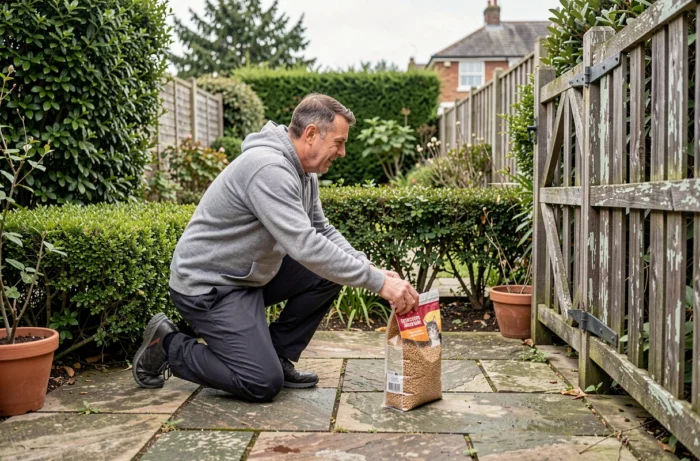
The protocol is simple. Place a bowl of strongly scented food (sardines, warmed wet food) close to your home, ideally near a door or passage that the cat knows. Add a worn cloth (t-shirt, unwashed pillowcase) to strengthen the scent landmark. Set up a camera, such as a trail camera or simply a smartphone in continuous recording mode, pointed at the bowl.
Hidden cats almost exclusively come out between 2 AM and 5 AM. Checking the bowl and the images each morning allows you to confirm the presence of the cat in the area before intensifying physical searches. If the food disappears without an image, consider that other animals (hedgehogs, stray cats) may be taking it, and adjust the positioning.

Online Ads and Social Media: What Actually Works
Posting on Facebook in “public” mode and on specialized platforms remains a lever, but its effectiveness entirely depends on the quality of the ad. A blurry photo with three lines of text generates no useful shares.
The ad should contain a recent and clear photo of the cat (front and side if possible), the exact location of the disappearance with the name of the neighborhood or street, the exact date, and a distinctive physical feature identifiable by a non-owner (mark on the snout, cut ear, short tail). Mentioning the microchip number is only useful for professionals equipped with a reader.
Avoid mentioning a reward in the public ad. This attracts well-documented scam attempts: individuals claim to have the cat and ask for a transfer before any “return.” The SPA and I-CAD regularly alert about this phenomenon.
We recommend contacting veterinarians and shelters directly within a few kilometers by phone and not just by online message. A wounded cat brought to a veterinarian will be scanned in the following hours, and the correspondence with your I-CAD declaration will occur automatically if your contact information is up to date.
Active ground search remains more decisive than digital dissemination. A cat hiding under a garden shed thirty meters from your home will never be found through a Facebook share. Ads serve to cover the scenario where the animal has been picked up by a third party, not to replace nighttime rounds with bait and camera.