
A colleague who systematically interrupts during meetings, a manager who sends aggressive messages at 11 PM, an inappropriate comment about a female employee’s appearance in front of the team. These situations, common in the professional world, fall under inappropriate behavior at work. They go beyond mere disagreement or temporary bad mood: they undermine the dignity of individuals and degrade the company’s atmosphere.
What transforms ordinary tension into inappropriate behavior
You may have noticed that the same word, spoken in a different tone or repeated every day, completely changes its nature? This is exactly the mechanism at work. Repetition or intensity transforms a clumsiness into a fault.
A disagreement over a file, even if heated, remains normal. However, as soon as an attitude targets the person rather than the work, we cross the line. Criticizing a deliverable is legitimate. Ridiculing its author in front of the team is not.
Three criteria help distinguish temporary tension from genuinely problematic behavior:
- Violation of dignity: the targeted person feels humiliated, belittled, or threatened in their integrity.
- The repeated or particularly serious nature: a single act may suffice if it is violent, but most situations involve an accumulation over several weeks or months.
- The power imbalance: the behavior is all the more damaging when it comes from a hierarchical superior, as the victim hesitates to react for fear of retaliation.
Understanding inappropriate behavior at work requires this framework, which is much more reliable than just the author’s intention. The famous “I was joking” changes nothing about the impact suffered.

Concrete examples of inappropriate behavior in the workplace
Putting precise words on these situations helps to identify them more quickly. Here are four common categories, ranked by increasing severity.
Repeated incivilities and lack of respect
Interrupting every time someone speaks, blatantly ignoring someone during a meeting, loudly sighing when a colleague asks a question. Taken in isolation, each gesture seems trivial. Cumulatively over weeks, they create an atmosphere of exclusion.
This type of incivility at work is the most underestimated. It often escapes managers’ radar because it leaves no written trace.
Insubordination and refusal of structure
An employee who repeatedly refuses their manager’s instructions, deliberately bypasses procedures, or publicly challenges their manager’s authority finds themselves in a situation of insubordination. This is not just a disagreement: characterized insubordination can justify disciplinary action, even dismissal for serious misconduct according to jurisprudence.
Moral or sexual harassment
Moral harassment is characterized by repeated actions that degrade working conditions and violate the rights and dignity of the employee. Sexual harassment includes comments or behaviors with sexual connotations imposed, even without physical contact.
These acts constitute criminal offenses. The employer has a legal obligation to prevent them, formalized in the DUERP (single document for assessing professional risks).
Abuse of managerial power
Setting deliberately unattainable goals, unjustly removing responsibilities, monitoring the break times of a single team member. Abuse of power uses hierarchy as a weapon, often in a subtle enough way to go unnoticed.
Impact on employee health and company climate
The consequences are not limited to temporary discomfort. The effects can be measured on three distinct levels.
On an individual level, the targeted person often develops sleep disturbances, anxiety, and a loss of self-confidence. In prolonged cases, the risk of burnout significantly increases.
On a collective level, the degradation of the work atmosphere is contagious. Witnesses who do not dare to intervene end up adopting avoidance strategies: they reduce their communication, take more frequent absences, and gradually disengage.
The cost to the company is rarely measured but is always real: increased turnover, absenteeism, decreased productivity, difficulty in recruiting when internal reputation deteriorates.
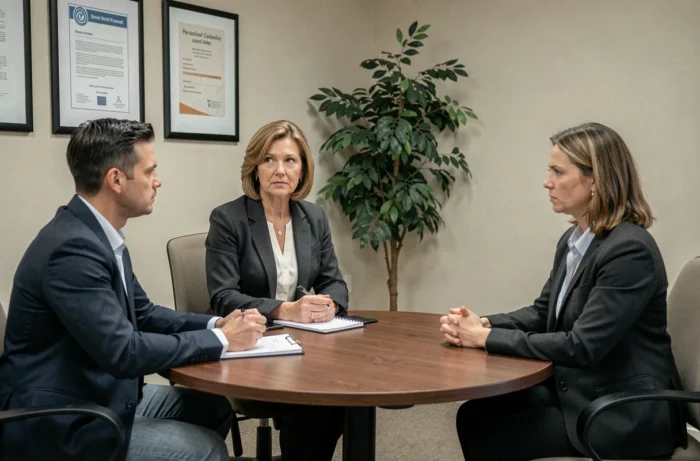
Reacting to inappropriate behavior: concrete levers
Whether you are a victim, a witness, or a manager, passivity always worsens the situation. Here are the steps that actually work.
Document the facts before taking any action
Note each incident with the date, time, location, potential witnesses, and the exact words spoken. An email sent to yourself immediately after the events serves as a dated element. Without written evidence, words remain fragile in the face of denial.
Report through the designated channels
The company’s internal regulations generally provide for a reporting procedure. The harassment referent, mandatory in companies of a certain size, is a direct contact person. Employee representatives on the CSE can also be approached.
Since the strengthening of the whistleblower protection regime in France, an employee who reports serious facts benefits from a more favorable proof mechanism in case of retaliation.
What the employer must do
The employer has a duty of care towards their employees. Upon receiving a report, they must initiate an internal investigation. The legislative work of 2026 on sexist and sexual violence also plans to impose a prompt internal investigation after the victim’s agreement.
On a disciplinary level, sanctions range from a written warning to dismissal for serious misconduct, depending on the nature and severity of the observed behaviors. The employment contract and internal regulations serve as a reference framework.
Inappropriate behavior at work cannot be resolved by ignoring it. The precise documentation of facts, prompt reporting, and the structured response from the employer remain the three pillars of effective management. For companies, incorporating the prevention of psychosocial risks into the DUERP and training managers to recognize early signals forms the foundation of a healthy professional environment.