
A parking space is one of the most accessible real estate assets to purchase. However, the question of its accounting and tax depreciation cannot be resolved in a single line: the treatment depends on the type of property (closed box, covered parking, open space), the chosen operating regime, and the legal nature of the holder. The regulatory framework mixes general accounting rules and specific tax doctrine, with direct consequences on the net profitability of a rental investment.
Open space, box, or covered garage: different tax treatments
Content discussing the depreciation of a parking space often refers to “parking” as a homogeneous block. The tax reality is more nuanced. An open space, akin to land, is not depreciable. Land does not depreciate over time, and the tax administration logically refuses to allow a depreciation charge to be deducted.
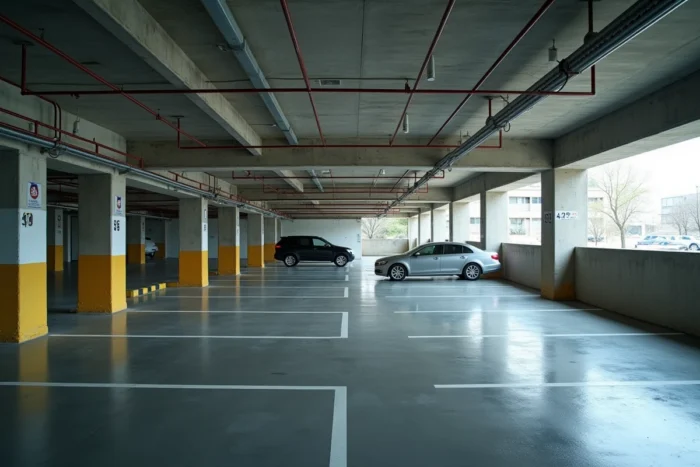
The situation changes as soon as a constructed element comes into play. A closed box, a masonry garage, or a space in an underground concrete parking lot constitutes built tangible assets. The “construction” portion of these properties can be depreciated, according to the same principles as a residential property or a commercial space.
To determine if depreciation is possible, one must first ask a preliminary question: is the parking space integrated into a construction, or is it merely a parking area on land? This distinction, rarely highlighted, conditions the entire reasoning that follows. When questioning the depreciation and duration of a parking space, this is the first point to verify even before consulting an accountant.
Accounting depreciation duration of a parking space: tax benchmarks
The tax administration does not publish a single depreciation duration for parking spaces. It provides indicative ranges by category of asset and tolerates that companies use the commonly accepted duration of use in their sector rather than the actual duration of use.
For a parking space in a built structure (concrete slab, covered structure), the commonly accepted depreciation duration is around twenty years. Some specific components, such as surface coating, ventilation equipment, or access control systems, can be depreciated over shorter durations, often between ten and fifteen years.
This component-based approach is not trivial. In a covered parking lot, the load-bearing structure, flooring, lighting, and signage do not wear out at the same rate. Breaking down the asset allows for accelerated tax deductions on elements that need to be renewed more frequently.
Linear or declining balance depreciation for a parking space
Linear depreciation remains the standard method for constructions. Each year, a constant fraction of the acquisition price is deducted. Declining balance depreciation, on the other hand, applies to certain eligible movable or industrial equipment according to the CGI, but not to the buildings themselves.
In practice, for a parking space owned by a company or through a SCI subject to corporate tax, linear depreciation over the estimated useful life is the rule. Technical components (automatic barriers, charging stations) may sometimes benefit from declining balance depreciation if their useful life exceeds three years and they are listed as eligible assets.
LMNP, SCI subject to corporate tax, direct ownership: depreciation according to the operating regime
The legal and tax regime of the holder profoundly alters the treatment of depreciation. Three scenarios deserve to be distinguished.
- In LMNP (non-professional furnished rental), depreciation applies by components on the real estate asset, including a parking space rented as an annex to a furnished property. The excess depreciation not deducted from the income of a given year can be carried forward indefinitely, which constitutes a notable tax advantage.
- In SCI subject to corporate tax, the reasoning also relies on the duration of use and component breakdown. Depreciation reduces the taxable income of the company, but the capital gain upon resale will be calculated on the net book value (purchase price minus depreciations taken), which can increase the exit tax burden.
- In direct ownership by an individual subject to real estate income (real regime), the depreciation of the property itself is not deductible, except under specific schemes like the former “Besson neuf” where parking spaces were included in the depreciable base under certain conditions (lease not distinct from the housing).
The choice of operating regime thus has a direct impact on the ability to depreciate a parking space and on the duration during which this deduction is effective.

Parking and operational valuation: what changes in 2026
A purely accounting analysis of depreciation is no longer sufficient to evaluate the relevance of an investment in parking. Several operational factors now weigh on net returns.
The installation of an electric vehicle charging station, for example, transforms a simple space into an asset with higher rental value. This station itself constitutes a depreciable asset over a distinct duration (generally between five and ten years depending on the equipment), sometimes with dedicated tax incentives.
The local market tension for parking also plays a role that depreciation tables do not capture. In city centers where spaces are scarce, the gross yield of a parking space can exceed that of a studio, with significantly lower management costs. Conversely, in sparsely populated suburban areas, the availability of free parking mechanically limits rents and extends the payback period.
The trade-off between gross yield and net yield also incorporates VAT. The rental of parking spaces is generally subject to VAT, allowing the taxable landlord to recover the tax on the purchase price and on renovation works. This mechanism reduces the actual acquisition cost and accelerates the economic depreciation of the asset, even if the accounting duration remains the same.
A parking space is not a fixed asset in an Excel spreadsheet. Its profitability depends as much on the tax framework as on its usage, the regime under which it is held, and the evolution of the local market. First, check if the asset is depreciable, choose the right legal structure, and then optimize the operation: this is the order in which a coherent investment is built.